
![[Open Data]](https://assets.okfn.org/images/ok_buttons/od_80x15_blue.png)
 DataCite (JSON-LD)
 Plasma-MDS (JSON)
 DCAT (RDF/XML)
 Project Open Data (JSON)
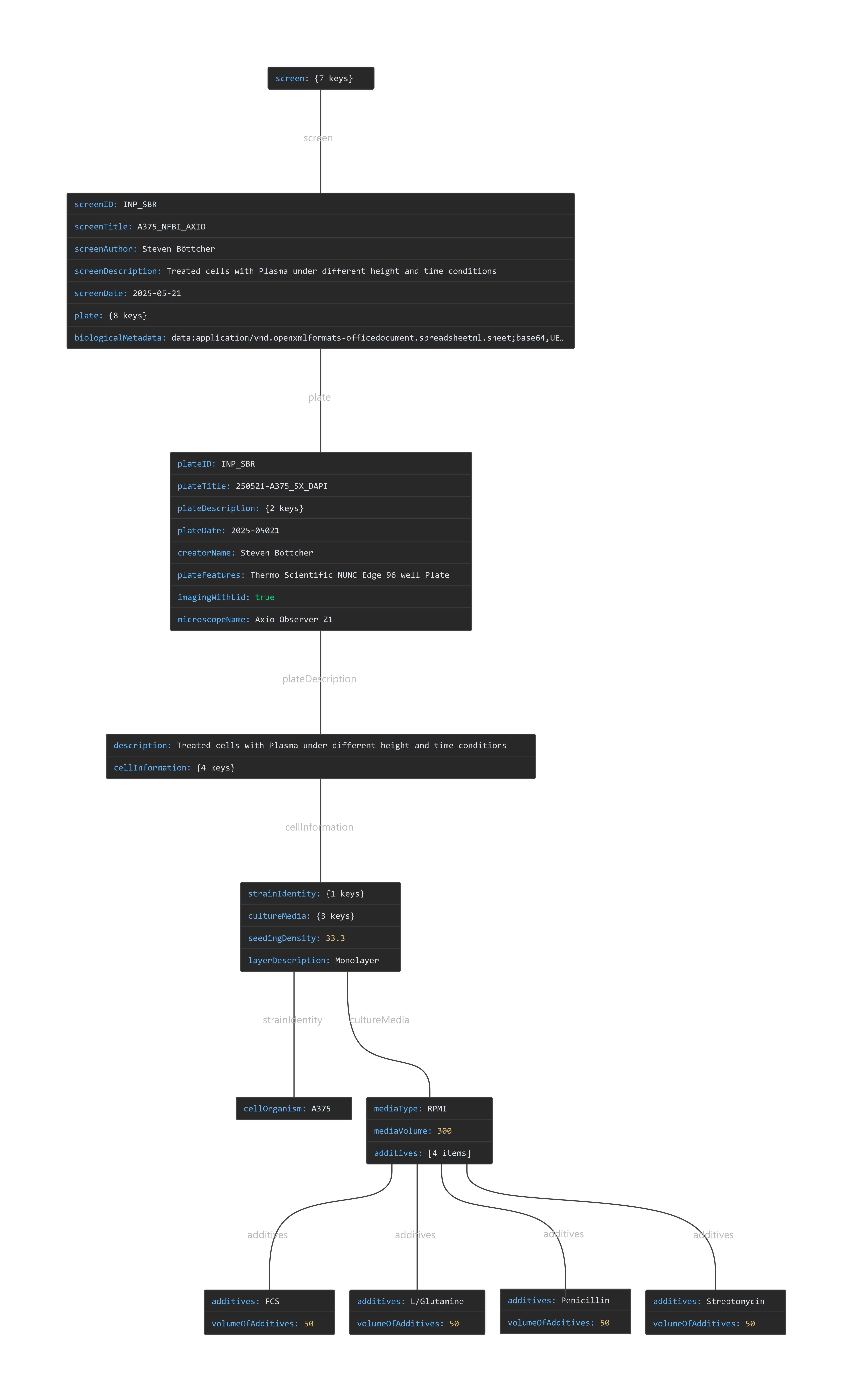
This dataset documents a complete, FAIR-aligned bioimage data workflow integrating Adamant, eLabFTW, and OMERO for an A375 melanoma cell imaging experiment. It includes stepwise visualizations of metadata collection, experiment documentation, data import, annotation, and image rendering across the three platforms. The dataset provides structured metadata at multiple levels, "screen", "plate", and "well", as well as instrument, captured using Adamant, eLabFTW, and Micro-Meta App. Comprehensive biological metadata for each well is supplied in CSV file. Detailed microscope-configuration metadata is provided as JSON files. All raw images are included in ".czi" format and corresponding "TIFF/XML" exports (images as .zip file). These materials enable users to test, reproduce, and validate the full workflow, from metadata acquisition and experiment documentation to data import, annotation, and image visualization, providing a FAIR reference implementation of the workflow.
| Field | Value |
|---|---|
| Group | |
| Authors | |
| Release Date | 2026-01-26 |
| Identifier | 6d14d866-9487-4688-84f3-7962a8b6c0ae |
| Permanent Identifier (DOI) | |
| Permanent Identifier (URI) | |
| Plasma Source Name | |
| Plasma Source Application | |
| Plasma Source Specification | |
| Plasma Source Properties | Power: < 3.5 W |
| Plasma Source Procedure | The device generates a stable cold plasma plume that delivers a mixture of reactive oxygen and nitrogen species (RONS) while maintaining a temperature safe for biological samples. More details are available in published literature, see https://doi.org/10.1088/1361-6463/aab3ad. |
| Plasma Medium Name | |
| Plasma Medium Properties | Argon (Ar) as feed gas: The plasma was generated using argon in ambient air at 1 atm, with a pre-pressure of approximately 5 atm. The gas temperature during operation remained in the range of 20–25 °C. |
| Plasma Medium Procedure | The argon flow rate was regulated using an external mass flow controller (Bronkhorst, NL; model F-201 CM with controller E-8412-A-10, 5 slm range), even though the plasma device itself is equipped with an internal flow regulation unit. |
| Plasma Target Name | |
| Plasma Target Properties | Human epithelial skin cancer cells A375 cultured in 300 µL RPMI medium supplemented with Fetal Calf Serum (FCS), L-glutamine, penicillin, and streptomycin (50 µL of each additive). |
| Plasma Target Procedure | Human epithelial skin cancer cells A375 cultured in 300 µL RPMI medium supplemented with Fetal Calf Serum (FCS), L-glutamine, penicillin, and streptomycin (50 µL of each additive) were exposed to plasma . Cells were seeded in a 96-well NUNC Edge plate (Thermo Scientific) and maintained under standard conditions. Plasma exposure parameters varied by treatment duration and nozzle-to-surface distance. All treatments were performed on a motorized XYZ stage to provide controlled positioning at RT and ambient humidity. |
| Plasma Diagnostics Name | |
| Plasma Diagnostics Properties | Axio Observer Z1 (Carl Zeiss) fluorescence microscope |
| Plasma Diagnostics Procedure | Cells were imaged using an Axio Observer Z1 (Carl Zeiss) fluorescence microscope, acquiring data in the DAPI channel. The imaging setup and associated parameters, including acquisition settings, objective specifications, and microscope configurations, were documented in detail. All relevant metadata from the microscope are available in JSON format (AxioZ1MicroscopeDescription.json). This metadata file contains information about the imaging conditions and setup. This metadata file is accessible for further analysis and integration with image processing workflows. |
| Language | English |
| License | |
| Public Access Level | Public |
| Contact Name | Ahmadi, Mohsen |
| Contact Email |
Data and Resources
- Bioimaging data management workflow for plasma medicine - Adamantpdf
Stepwise visualization of metadata collection in Adamant, including...
Download - Bioimaging data management workflow for plasma medicine - eLabFTWpdf
Stepwise visualization of the sequential steps for accessing experiment...
Download - Bioimaging data management workflow for plasma medicine - OMEROpdf
Stepwise visualization of the comprehensive workflow for data import,...
Download - Bioimaging data management workflow for plasma medicine - workflow metadata hierarchypng
The hierarchical structure of metadata resulting from the the screen–plate–...
Download - Bioimaging data management workflow for plasma medicine - screen metadatajson
JSON file containing all biological, experimental, and instrument (...
Download - Bioimaging data management workflow for plasma medicine - biological metadataxlsx
Excel-based biological metadata for all wells of the A375 showcase...
Download - Bioimaging data management workflow for plasma medicine - microscope metadatajson
Full microscope-configuration metadata acquired using Micro-Meta App,...
Download - Bioimaging data management workflow for plasma medicine - screen metadata schemajson
JSON schema for creation of the metadata-collection form using Adamant.
Download - Bioimaging data management workflow for plasma medicine - raw image datazip
This dataset contains the raw imaging files for A375 cell line acquired...
Download